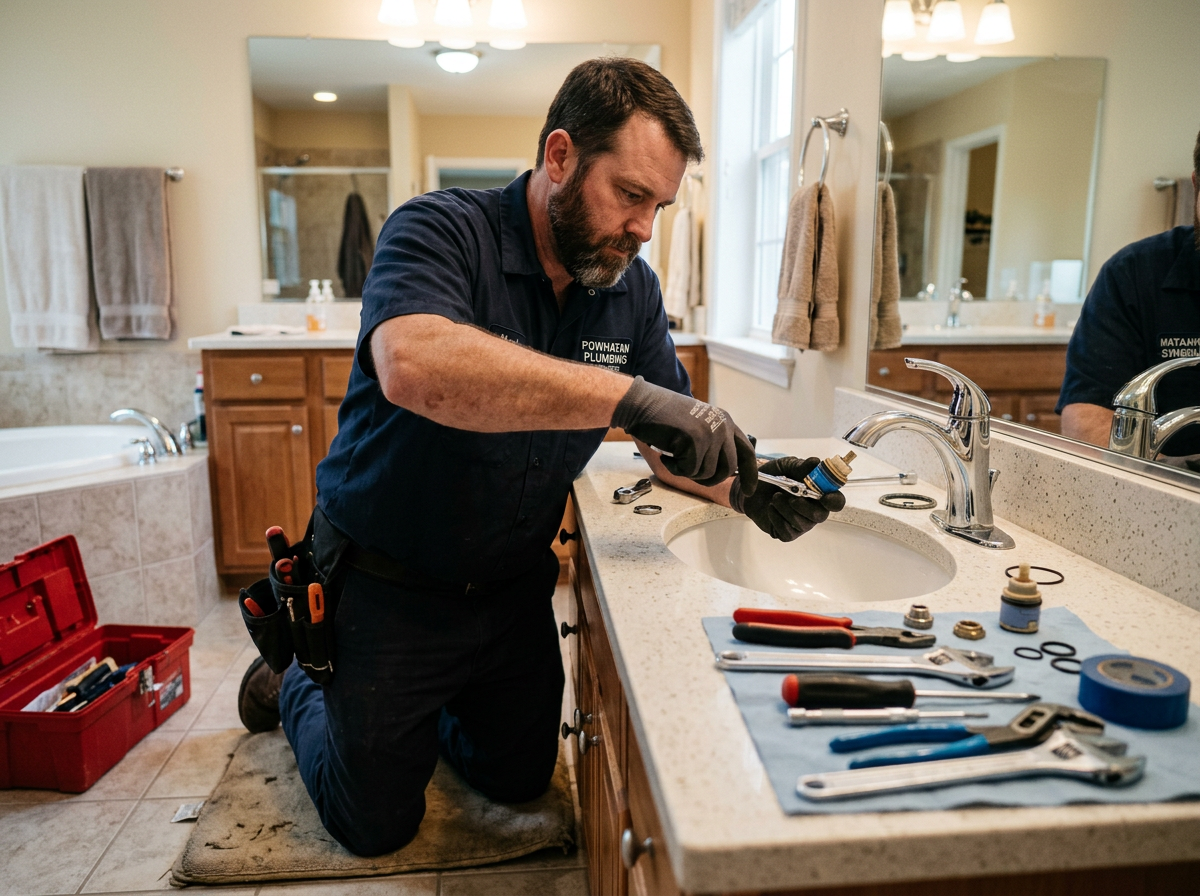
Bathroom sink faucets get less wear than kitchen faucets, but they fail in their own ways: a drip that keeps you awake, a handle that spins, a pop-up drain that won't open, or a slow leak inside the vanity that nobody notices until the cabinet bottom falls apart.
What goes wrong
- Dripping spout: worn cartridge, washer or ceramic disc.
- Two-handle faucet where one side drips: that side's stem or cartridge.
- Handle loose or spinning: a stripped stem or worn handle adapter.
- Water around the base: failed gasket or loose mounting nut.
- Pop-up drain stuck open or closed: the pivot rod or its seal.
- Wet vanity floor: supply lines, valve packing or the drain tailpiece.
Why vanity leaks matter
A vanity cabinet hides a lot. A slow drip from a supply connection can soak the cabinet base and the subfloor for months, and in homes on a crawlspace, which is common around Powhatan, the water can reach the joists below. If you see swelling, staining or a musty smell in the cabinet, close the valves under the sink and have it looked at.
How the repair is done
The faucet is taken apart at the valves and the worn cartridge, stem or seal is replaced with the matching part. The pop-up assembly is adjusted or replaced, and the supply lines and shut-off valves are checked. Older chrome-plated supply tubes and stiff valves are worth replacing while the faucet is apart.
If the faucet is past repair, bathroom faucet replacement is explained first. For a drip in the shower instead of the sink, see shower and tub faucet repair; for a general drip, leaking faucet repair.
Call for a quote on faucet repair for your bathroom.
How it works
- 1
Inspect
Faucet, drain and vanity checked for the leak source.
- 2
Replace worn parts
Cartridge, stem, washer or gasket matched to the faucet.
- 3
Fix the drain
Pop-up adjusted or replaced.
- 4
Test
Valves, supplies and drain checked with water running.