2026-09-29 ·
Hard Well Water and Your Faucets: A Powhatan Guide
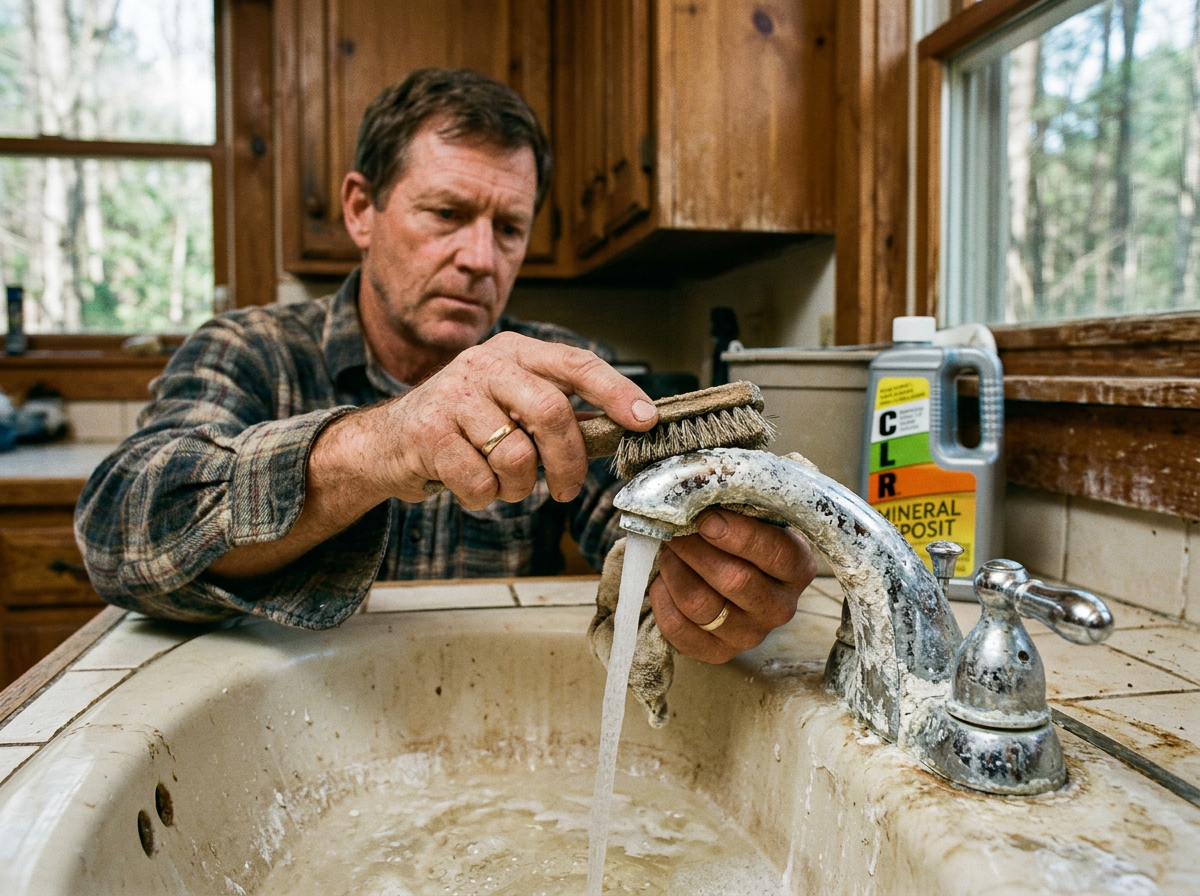
Most homes in Powhatan County draw their water from a private well. Well water has real advantages, but it doesn't go through a treatment plant, and whatever is in the ground ends up in your plumbing. In this part of central Virginia that often means hardness minerals, iron and fine sediment. Your faucets are where you'll see it first.
What hard water does inside a faucet
Hard water carries dissolved calcium and magnesium. When it heats up or evaporates, those minerals come out as scale: the white crust you see on a showerhead. Inside a faucet, the same scale builds on the surfaces that are supposed to seal against each other.
- Ceramic disc cartridges stop sealing when scale builds between the discs, so the faucet drips even with the handle fully closed.
- Washer-and-seat valves in older faucets get their seats pitted, so a new washer can't seal properly for long.
- Handles get stiff as scale builds around moving parts.
- Aerators clog and flow drops a little at a time.
What sediment and iron do
Sediment is fine sand and grit from the well. It settles in the smallest openings first: aerator screens, cartridge inlets and spray heads. Grit also scores rubber O-rings every time the handle turns, which is why a faucet on sediment-heavy water can leak around the handle after only a few years.
Iron leaves orange or brown staining in sinks and tubs, and can build up in the same places as sediment. It's more of a nuisance than a hazard, but it does shorten the life of faucet parts.
Signs your water is wearing your faucets
- A faucet that drips again within a year or two of being repaired
- Flow that gets weaker gradually at every tap
- White crust on aerators and showerheads
- Orange or brown staining around drains
- Stiff handles that were smooth when new
If one faucet is dripping, leaking faucet repair covers what a proper rebuild involves, including cleaning scale from the seats. If flow is weak everywhere, see low water pressure at the faucet.
What helps faucets last
A sediment filter at the pressure tank. This is the most useful single thing for faucets on a well. Change the cartridge on schedule, which depends on your water but is often every few months.
A softener, if your water is hard. It removes the minerals that cause scale. Softeners need salt and occasional servicing to keep working.
Faucets with ceramic disc cartridges. They generally handle hard water better than older washer-style valves, and replacement cartridges are easy to find for major brands.
Cleaning aerators. Unscrew the tip of the spout every few months, rinse the screen and soak it in vinegar if it's crusted.
How to find out what's in your water
You don't have to guess. A basic well water test shows hardness, iron, pH and whether there's bacteria present. Many homeowners test when they buy the house and never again, but well water can change over the years, especially after drought, flooding or work on the well. Your local extension office can point you to testing options, and some water treatment companies test as part of a quote.
Once you know the numbers, you can choose treatment that fits. High hardness points to a softener. High iron may need an iron filter. Heavy sediment needs a sediment filter, sometimes with a spin-down pre-filter in front of it. Low pH, or acidic water, is worth knowing about too, because it can corrode copper pipes and faucet parts from the inside.
Reading the clues in your sinks
Your fixtures tell you a lot before any test does:
- White, chalky crust on aerators and around the base of the faucet: hardness.
- Orange or rust-brown stains in the sink or toilet bowl: iron.
- Black specks or staining: often manganese, which behaves much like iron.
- Grit in the aerator screen when you unscrew it: sediment.
- Blue-green staining below a faucet: acidic water reacting with copper.
Cleaning scale safely
White vinegar dissolves most household scale. Unscrew the aerator and soak it overnight, or tie a bag of vinegar around a showerhead. Avoid harsh abrasives on the faucet finish, and don't soak finishes like brushed nickel or matte black for long without checking the maker's guidance. Cleaning the outside helps, but it doesn't reach scale on the cartridge. If the faucet still drips after cleaning the aerator, the cartridge is where the problem is.
A realistic expectation
On untreated hard well water, even a good faucet will need a new cartridge sooner than it would on treated water. That's normal, not a sign the faucet was bad. The aim is to make the repairs less frequent and the flow steady, and treatment at the tank does that for every fixture in the house at once.
If you live out toward Flat Rock or across the river in Goochland, you're almost certainly on a well, and this applies to you. For choosing a new faucet that will stand up to your water, see our guide on whether to repair or replace a faucet.